|
cappadocia geohistory
The
Geohistory
60 million years ago in the Oligocene and
Pliocene, the Taurus mountain chain arose as a subsidiary of the
Alpine system. The consequent warping of the Anatolian Plateau to
the north resulted in the appearance of volcanoes, of which the two
most massive are Mounts Erciyas and Hasandagi, the one in eastern
and the other in western Cappadocia. Midway
between them is situated the smaller Mt. Göllüdağ.
Although no
historical record exists of activity from
these ancient volcanoes, an eruption is
depicted in one wall painting at Catalhöyük, a painting which in
fact is among the oldest known to archaeology. A temple
of fire near Mt. Erciyas bears evidence that the Persians held this
volcano sacred. And a coin from
Ceesarea is engraved with an image of Erciyas spewing
lava. In all likelihood these representations stem from an awed
receptiveness to ancient legend, rather than from direct experience.
Over millions of years
the ash laid down by these two volcanic furnaces gradually formed a
layer of
soft tuff. This in turn was patched over in places with
a thin layer of basalt lava. This basalt
cracked and then split under
weathering, allowing rain water to seep
down through the fissures and slowly erode the
underlying tuff. Time and widening gaps ushered in a thermoclastic effect, alternating heat and
cold that broke down the rock's resistance, and to this was
added the constant rub of wind. What emerged
were tall cones surmounted by caps of hard
basalt, in clumps or teeming ranks to which the Turks - sensing
some mystery or spell - have given the name "fairy
chimneys."
Where there is no
protective basalt layer, or where it
has been worn away, eroding wind and water
have sculpted out lovely valleys,
nearly all of which lie south
of the Kızılırmak.
Steep canyons of
andesite and basalt, in the rocks
of which have
collected softer formations, join these
valleys to the plateau.
Soganlı and Ihlara are canyons in this mold, the latter truly
vertiginous, attaining a depth
in places of 650 feet.
Nooked and recessed,
sheltered from the pressing
north wind, these valleys have developed a near-temperate climate with
soil that attracts the smallholding
farmer and blooms forth in orchards and basking
vineyards.
Cappadocia
Through the ages
The
Neolithic and chalcolithic Ages
The most highly-developed
form of Neolithic culture
was found in Anatolia to the north of the
Taurus. Settlements dating back
nine to ten thousand years have been brought to light at Hacılar,
Canhasan, Çatalhöyük and
other locations on the plateau. Here dwelled small communities which
depended for their livelihood on agriculture and livestock, and who
worshipped the mother goddess. Artifacts which remain as
testimony to the well developed taste of these peoples
include mirrors of polished obsidian, elegant
personal ornaments, colorful ceramics and what to our eye are
surprisingly contemporary statuettes of the mother goddess, coarsely
but earthily voluptuous.
At the best-preserved
site, Çatalhöyük, archaeological digs in the 1960s uncovered some one thousand
earthen dwellings, together with the oldest extant weave fabric and
the oldest wall paintings in the world.
The discovery of
copper and its fashioning ushered
in the Chalcolithic
Age, which in Anatolia corresponds to the 6th millennium B.C.
Early
Bronze Ages
As mining and metal-working
grew in importance,
the population
centers of inner Anatolia were drawn northward and eastward. Minor
kingdoms rose up to
unite the towns which tended to concentrate along
the Kızılırmak River.
The result was a people referred to in Assyrian and later Anatolian sources as the
Hatti, with a civilization that modern-day archaeology
describes as ProtoHittite. The refined taste and skill of
these people in metal-working, whether using
alloys such as bronze and electrum or shaping precious metals,
particularly gold and silver, command our respect even today and
serve to define an age whose broader description is Early Bronze. It falls roughly
within the 3rd millennium B.C.
The richest Hatti
finds have come in the royal tomb
at Alacahoyuk; traces
of the culture are encountered in Troy and at the far western end of
Asia Minor.
The Early Bronze saw a
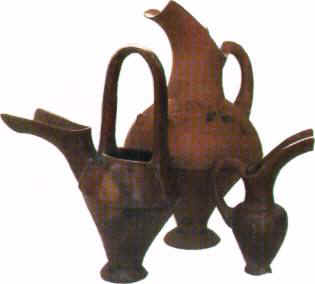
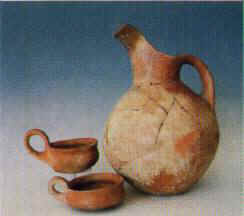
revolution in pottery making
with the introduction of the potter's wheel and
the appearance of a new kind of ceramic, the Cappadocian. The tradition
begun five thousand years ago
continues today in the heart of Cappadocia at Avanos, where the same wheel, the selfsame methods, are
still used to produce elegant and servicable ware.
As farming and
livestock breeding, metal-working
and pottery developed
and flourished, and as townships arose, some type
of trade was inevitable on
both a local and more
farflung scale. Assyrian traders were more than willing to assume this
responsibility. Alongside every Hatti principality-township, local
authority permitted the establishment of an Assyrian trading colony
or kharum. The largest of
these colonies, and a sort of headquarters for all of
them, was that at Kültepe (Kayseri), known
as the Kanech Kharum.
An invaluable archive
comprising some thousands
of Assyrian cuneiform tablets in clay has been found at
Kültepe, giving us a record of the day-to-day correspondence carried on by these merchants.
Quite detailed information can
also be drawn from them about
the land of Hatti, and thus of the inhabitants of Cappadocia.
Seals imprinted on
clay were first employed in Assur, and their use became widespread in Anatolia;
so
much so that they are referred to by some scholars as "Cappadocian seals."It is now wellestablished that the Hatti language
bears no relation to
any still living language. It was
an isolated tongue peculiar to inner
Anatolia, but in that domain it
was undisputed at the time, with Luwian, the language of
south western Anatolia, having a
secondary role.
The
Hittites
Somewhere around 1900 B.C. there appears in
the land of Hatti a folk who call
themselves the people of Nesa. Where they originally came
from is a mystery, nor is it
known what they were called there. Even
the name Nesa is now presumed to derive from
"Kanech," mentioned above, which was their first
home in Asia Minor.
These people merged
with the indigenous Hatti,
forging from the two cultures one that was new and unique. In time they
even came to take their name from that of their adopted home, and
henceforward were known as the
Hittites.
The Hittite period stretches from 1900 to
1200 B.C. To begin with there were
small city-kingdoms, sometimes resolving their differences
through warfare. The first to
gain the ascendancy was King Pitkhana of Kussara, whose son Anittas
established absolute dominance, destroying rival Hattusas in
the process. A succeeding king,
Labarnas, was to realize
the strategic importance of Hattusas and in fact rebuild it as his capital.
Labarnas (1680-1650 B.C.) founded a dynasty.
His successor had the
appellation "Hattusilis" or He-of-Hattusas. These
two kings, and Mursilis I who followed
them, expanded their domains in every direction,
with particular distinction earned to the south in victories over
Babylonia.
It was Telipinues
(1525-1520 B.C.) who refashioned the state through the giving of new
laws. Suppiluliumas, however, was
unquestionably the greatest Hittite king. Reigning from 1375 to 1335
B.C., he succeeded in settling accounts with the Mittani Empire,
which had established itself as a formidable rival. It was
this king's practice to make treaties with conquered nations rather than take slaves: thus, the Hittile Empire
begins with his reign.
The neighboring empire
to the south was that of
Egypt. At one point the widow of the
boyking Tutankhamun beseeched
Suppiluliumas for the hand of
one of his sons, but the plan was not consummated.
Mutwattalis
completely outgeneralled the proud pharoah Ramses II to win
what must rank among the
most important military triumphs in history: the result was the first
written peace treaty and pact of non-aggression
ever, signed between the Hittites and the
Egyptians.
The Hittites were keen
breeders and trainers of
horses, and developed the first light war
chariots.
They were also
the first to fight with iron weapons. The
plumed helmet and warrior's tunic later encountered in the Greek and Roman armies also made their first
appearance with the Hittites.
Assailed from every
direction in the 13th century
B.C., the Hittite Empire staggered.
The invading Mushki (as the Phrygians are
referred to in Assyrian sources) overran the kingdom as the confederacy
broke up.
The
Tabal Kingdom

When the Great Hittite
Kingdom collapsed there
sprang up a number of smaller kingdoms
which saw
themselves as its
inheritors. Among these was the
Tabal kingdom
founded in
Cappadocia. Forming a
confederacy with Carchemish
and Kuwaliya, it was known as the Great Kingdom to
distinguish it from these
latter.
Contemporary with the
later Hittite states were Phrygia to the west and
Urartu to the east. Pillaging
hordes of Phrygians poured through the passes
into Anatolia around 1250 B.C., later establishing dominion in
west central Anatolia, where they merged with
the local folk and took up an agricultural
way of life.
To the east Urartu, whose people were
descended from the Asian
Hurrians, were noted for their architecture and
skilled metal-working. Cappadocia traded with both slates,
and each influenced the other.
The Phrygian kingdom was overthrown by the
Cimmerians: their last
king, Midas, took his own life upon
his defeat at Cimmerian hands in 676 B.C.
With the Phrygian
kingdom gone, Lydia rose to
prominence in western Anatolia. Apart from being
able seafarers, the
Lydians took full advantage of
the fact that their kingdom lay athwart the trade
routes
linking the Aeolian and Ionian confederations
with central Anatolia. The Lydians invented
money, and the name of
Croesus, their king, stands for vast riches even today.
The
Persian Empire
When Lydia expanded
eastward and crossed the
Kızılırmak , they ran up against the Medes, by far
the most powerful
nation in near Asia. As the nations battled on a day in 585 B.C., the sky grew
dark.
This eclipse of the sun led the two hosts, in
terror, to lay down arms and declare a
peace. The Kızılırmak
became the boundary dividing the Lydians
from the Medes in Asia Minor.
Thirty years later,
when the Persians supplanted the
Medes, they divided
their empire into semi-autonomous provinces called satrapies. The lands
which this Iranian people acquired to the
south and east of the Kızılırmak
they named "Katpatukya," meaning in Persian "Land
of the Beautiful Horses." We learn from Herodotus that the
Greeks knew the Cappadocians as
Syrians, in which they were of course
mistaken.
In 547 B.C. King Croesus of Lydia crossed
the Kızılırmak to attack Persia, but incurred defeat at the hands of Cyrus. A second
battle, in the vicinity of Sardis further west, spelled
Lydia's doom. Not until the
invasion of Alexander would the Persian yoke be
cast off in Anatolia.
Though
the Persians'
religion was
Zoroastrian, theirs was a tolerant rule which left subject peoples free
to worship as they pleased. Local languages, too,
went unmolested.
In the reign of Darius
I Anatolia was divided into
three great satrapies. Cappadocia, which
was one, paid the emperor annual
tribute of 360 talents, 1500 horses, 2000 mules and 50,000 sheep.
In 407 B.C. Darius III
made his younger son Cyrus
satrap (governor) of Greater Phrygia and Cappadocia. When the
elder brother, Artaxerxes Memnon, assumed
the throne in 404, Cyrus brought against him an army of one
hundred thousand Anatolian conscripts,
with an additional levy of ten thousand Greek
mercenaries. It is this mighty adventure which Xenophon - one of the Greek generals -recounts in his
Anabasis (The Retreat Of The Ten Thousand)
It was this same
Artaxerxes II who in 362 quashed
the revolt of the Cappadocian satrap
Damates and divided the province
into two smaller satrapies, northern
and southern. The road network which had already begun to
take shape under the Hittites was
further expanded by the
Persians. The Royal Road which joined Persepolis, Aegean
capital, to Mesopotamian Susa quite naturally
made its way through Cappadocia.
The Persians brought with them into the new
land stirrings of Zoroastrianism.
A belief that pitted Ahura Mazda,
the force of good, against Ahriman in eternal
warfare also held that fire was sacred, and turned the volcanoes Erciyas and Hasandagı into objects
of worship. A fire-worshipper's altar with a relief depicting
a priest who holds sacred fire-stick scan be seen today in Bünyan
near Kayseri.
The later stages of
the Persian Empire saw the cull
of Mithra and Anatita reach Cappadocia.
Mithra was the god of light,
Anatita the mother goddess, one in a
long succession beginning with she of Anatolia and maintained ultimately in Cybele, Artemis and Aphrodite.
Alexander
And The Diadochi
In 333 B.C. Alexander
assembled his armies at Gordium. He remained a while in Ankara, at
which time he gained Cappadocia
and left it under the rule of a governor.
The Macedonian assault
had upset the balance.
The ruling class in Cappadocia, joining forces with those who had a stake
in the old order, in 332 B.C. declared Ariartes I king of the domain.
This Persian aristocrat succeeded
in extending the frontiers of his realm
as far as the Black Sea, but Alexander's stepson Perdichas marched
on him to complete the conquest of the region.
Now the governorship
of Cappadocia was placed in
the hands of Eumenes, archivist to Alexander. It
was
around this time that what was to prove incessant conflict among the
diadochi (Alexander's generals) began. In Cappadocia Eumenes defeated the
renowned Crateros, the death of the latter resulting.
The other diadochi
banded together against Eumenes and, meeting in Antioch in 321 B.C.,
redivided the empire
among them. To rid Cappadocia of Perdichas
and Eumenes, Naib Antipatros made Antigonus
commander-in-chief of the armies in Asia.
Antigonus had earlier overcome Eumenes
without, however, being able fully to subdue him. Polypheron,
succeeding Antipatros, took sides with Eumenes,
but the latterthough he had seized the treasury
in Cilicia and acquired new supporters in the southsuffered
another defeat at the hands of Antigonus. He was captured and put to
death (316 B.C.)
In the years that
intervened, the Seleucids, embroiled with Rolemy and his followers, were
unable
to prevent these uprisings in Asia Minor, Mithridates on the Black Sea
and Nicomedes along the eastern
Marmara proclaimed the kingdoms of Pontus and
Bithynia respectively.
Celts, or as they were called Galatians, had been instrumental in
the founding of Bithynia and now were granted territory in Anatolia
around presentday Ankara and Eskişehir. This region to the
northwest of Cappadocia would
henceforth be known as Galatia.
The
Kingdom of Cappadocia
Meanwhile Ariartes II,
adoptive son of the first Cappadocian king, returned from hiding to
establish the kingdom anew. Although
the coasts of Asia Minor were lastingly transformed
by Hellenism, this culture seems to have made little
impression on Cappadocia.
Ariartes III extended his domains by the
addition of Malatya and Marash to the east, while Ariartes IV expanded
westward with the acquisiton of Konya. The
latter king allied with Pergamum to impede for a while
the Roman advance into Asia Minor. By the time
of Ariartes V, Mazaka (Kayseri) and Tyana (Kemerhisar)
were beginning to fit the Hellenistic architectural mold.
In the reign of
Ariartes Epiphanes VI (125-111 B.C.)
the kingdom was annexed by Pontus. The
ensuing years saw Cappadocia
change hands frequently, with Pontus and Rome alternating as
masters. The region was a constant battlefield, with its own rival
kings often at war. Finally, in 66 B.C., Pompey invaded Cappadocia
and set Ariobarzanes I on the throne
as vassal. He in turn was followed by his son Ariobarzanes II
(66-52 B.C.) and Ariobarzanes III (52-42
B.C.)
When Julius Caesar
waged war against the king of
Pontus he set up camp in Mazaka, whose name
then changed to Caesarea, today's Kayseri.
These wars led once again to the plunder and ravaging of Cappadocia.
When Caesar had been
assassinated, Cassius
made his way to Cappadocia where he ordered a further killing, the murder of Ariobarzanes III. This king's
successor, Ariartes Eusebes Philadelphos, was fallowed by
Archeleos, who received the firm support
of Anthony and then of Augustus, the latter of whom went so far as to bestow on the king a portion
of Cilicia. Meanwhile, in what was now Caesarea, a mint was
set up and began producing coin.
Archaleos, who at all
times acted strictly in the interests of Rome, was the last
Cappadocian king. Upon
his death the domain became a Roman province,
beginning in A.D. 17.
The
Roman Era
Under Rome, Cappadocia was a vast province
extending from the Taurus to the Black Sea, from the Salt Lake (Tuz Gölü) to the Euphrates, and including
all of Galatia. Legions were stationed here against
potential incursions from the east, and major road construction was
carried out. At this period the eastern
frontier was subjected to harrassment by the
Parthians.
During the reign of
Septimus Severus (192-211
A.D.) Cappadocia was the scene of military disturbances. However,
economic ties between Smyrna (Izmir) on the Aegean and Kayseri in
Cappadocia became so strong that
coins were impressed that bore
the legend "Union."
In the decade following A.D. 220 Cappadocia
was invaded by the Sassanid king Artaxerxes. The response
from Gordianus 111 of Rome was to gird the city of Kayseri
with defensive walls. In the time of Valerius
I a Sassanid attempt to take Kayseri failed, but
in 251 the city was sacked and razed. During this Sassanid
campaign Valerius suffered the ignominy
of falling prisoner. Then in 254 a wave of Goths
swept through, and in 257 the Sassanids again
put this province to the torch. In 267 it was again the Goths.
During these troubled times Cappadocia
was involved in the gradual spread of Christianity. A
bishopric was established at Kayseri, with Alexander
Phrmilien, pupil of Clement of Alexandria, as
one of the first prominent bishops. In the 4th century
Kayseri was to produce three great clerics: Basil the Great, his
brother Gregory of Nysse and his friend
Gregory of Nasiensis. Basil, bishop of Kayseri from 370
onward, was the author of many precepts and doctrines still adhered
to in the Christian world.
He denounced as heresy the Arianism that
was being espoused by the
emperor, and at the same time opposed the excesses of the
landed aristocracy. In the
environs of Kayseri he built a home for the aged and infirm,
a shelter for the poor, and an inn to welcome
travelers. Julian the Apostate, who tried to restore the
pagan religion to his empire, abhorred Basil
and even forbade all mention of Kayseri itself. The
emperor Diocletian, to reduce Basil's influence, divided Cappadocia
in two.
The
Byzantine Era
In A.D. 396 when the
Roman Empire was divided
into eastern and western halves, Cappadocia naturally fell within the
boundaries of the former.
Byzantium was a
cauldron of religious sectarianism,
the nature of Father, Son and Holy Ghost a
never-resolved question. Councils were convened to debate the nature of Christ, whether divine or human
or in some way both. Each new council overturned the decrees
of the last, and divisiveness ultimately blossomed into armed conflict.
In A.D. 449 the emperor Theodosius declared
for Monophism, a doctrine which
held that Christ partook of the divine nature only. Then in
451 the emperor Marcianus
convened a spiritual council in Chalcedon (now Istanbul's Kadiköy)
to reject the doctrine. Under Justinius and Justinianus,
Monophisites were severely persecuted.
At the beginning of the
7th century there was instituted a system of
governing by themes, according to
which lands were parcelled out in return
for military fealty. One of the themes thus created was Cappadocia.
The enemy to the east of Byzantium were the Sassanids,
whose elimination by the Arabs gave respite until the Arabs
themselves began to pose a threat.
Indeed, under the caliph Othman, Syrian Moslem troops
advanced as far as Kayseri, the environs of which they occupied. In
later years these Arab invasions took on a character that was annual
and even seasonal.
In 708 the Arabs
captured Tyana (Kemerhisar). In 712 Amasya and Yalvac. fell, and in
713 Heraclea
(Eregli), thus
bringing practically all of Cappadocia under Arab occupation. In 726
Moslem armies pillaged Kayseri.
However, the Arab tide was stemmed
by the Byzantine victory at Akroines, near Afyon.
After this battle, in
which the renowned Seyyit Batal
Ghazi was killed, Byzantium regained
control of the lands as far as Malatya. It was the emperor Leon III who
achieved this success. Of Syrian extraction, he was
also the emperor who initiated the iconoclastic
movement. During the 4th and 5th centuries the love
of icons and images among Christians had reached the point of
idolatry, and this led to a reaction.
Partly under the influence of Islam and partly to weaken the grip
held on society by the priests, Leon III in 726 banned all
images of Mary and the saints. When
an enraged crowd lynched the officer charged with removing Christ's
image from above the palace gate, Leon quelled the uprising
savagely.
The iconoclastic
movement lasted more than a century, and in fact the antagonism between
the iconoclasts and those who cherished images never fully abated.
Cappadocia's role in the troubles was ambiguous:
although there was an iconoclastic influence
in the region, devotees of the image easily found
a place to hide here and continue their forms of
worship. In 780 Harun, heir apparent to Mehdi the Caliph of
Baghdad, displayed such valour on a campaign to Cappadocia that his
father declared him rashid, mature and ready. With Harun al-Rashid
on the thone. the Byzantine empress Irene was able to stop the
advance of the Arab armies only by paying tribute.
In 802 Irene was
deposed and replaced by her
treasurer, Nicephorus. When he refused to pay the tribute,
Harun marched and captured Tyrana. He then demanded, and
received, even greater tribute than
before.
The emperor Romanos Diogenes, who was
defeated by Alp Arsian at the
epoch-making battle of Manzikert in 1071, was Cappadocian in origin.
For long, the empire had
lought to hold back the advancing tide
of Patzinak and Seljuk Turks. With Manzikert the dam broke, and the
issue was never again in doubt.
The
Seljuks in Anatolia
From the early 11th
century onward there were
Turks concentrated in eastern Anatolia. In 1066, the
year of the Norman
Conquest of England, the Seljuk
Bey Elbasan rebelled
against his sultan, Alp Arslan,
and fled with his armies to the heart of
Anatolia. Intent on taking him,
Afshin Bey carried the pursuit as far
as Kayseri, which he in fact captured. Elbasan was forced to
do battle with Byzantine troops, and carried
the day. Nevertheless, with Afshin breathing down his neck, Elbasan
crossed over and sought refuge with the Byzantines he had
just defeated. This was the first
of many incursions into Anatolia by
the Turks and Turcomans. It was the aim of Romanos
IV Diogenes, in raising an army to meet Alp Arslan, to dispel
the threat once and for all. But the
battle, fought on August 26, 1071 at Manzikert near Lake Van, ended
in an overwhelming Turkish victory during
which the Byzantine emperor was taken prisoner. Although Alp
Arslan delivered up his captive, in Byzantium pretenders to the
throne were waiting for Romanos on his return. They blinded and then
murdered the emperor, rendering
the pact he had concluded with Alp Arslan void. With a free conscience,
Artuk Bey and his hosts now advanced to the shores of the Marmara.
Before long Alp Arslan
himself fell to an assassin
and was replaced by
his son Melikshah. When the
uncle of the latter waged internecine war against
him, Artuk Bey's
conquests had to be halted. In the confusion, Suleimanshah, son of
Kutalmish, seized lands extending from Konya (Iconium) to iznik (Nicaea)
and on these territories established the Seljuk Sultanate
of Anatolia. The governorship, or beylik, of
the vilayet embracing Kayseri and Nevşehir was bestowed upon Ebu'l Ghazi Hasan. It is from him that
the towering Hasan Dagi (dag = mountain) near Aksaray takes its
name.
North of the Kızılırmak
lay the Danishmandid Emirate. The Seljuk sultan, Kilidje Arslan I,
had been
thrown together with the Danishmandid ruler
Gumüshtekin in
breasting the First Crusade, but a
later dispute over
possession of Malatya made rivals of them.

Kilidje (Kiliç)
Arslan II (1155-1192) divided the sultanate among his eleven
sons. This misguided attempt at fairness led to dissension and finally war.
The Emirate of Kayseri and Nevşehir had fallen to
the lot of Nureddin Sultanshah. The Emir of
Sivas, Kutbeddin Melikshah,
took Konya to compel his father
to march on Kayseri. But Kilidje Arslan II did the opposite:
he took refuge with Nureddinshah instead. The
treatment he then received, however, convinced
him to (lee into the camp of his youngest son,
Giyaseddin Keykhusrev the Emir of Uluborlu. Kilidje
Arslan later advanced in strength on Konya to wrest the
throne again from Kutbeddin. At his death in
1192 he bestowed his rule upon Giyaseddin, then at
his side.
Meanwhile Kutbeddin
was effecting the conquest of
the Kayseri-Nevşehir region (1195). Rükneddin
Suleiman shah, the Emir
of Tokat who until that time
had remained on the sidelines, seized the
opportunity created by Kutbeddin's death in 1196 to march on
Konya. Banishing Giyaseddin Keykhusrev, he
took possession of the Seljuk
throne, whereupon his first act
was to attach Kayseri Nevşehir administratively to the capital.
The zenith of Seljuk
power came in the reign of
Alaeddin Keykubat (1220-1237), when the Anatolian
Seljuks expanded their trade routes and erected the most graceful mosques,
tombs and public buildings,
while founding the
medical colleges known as
Daruşşifa. These works were bestowed not only on the
two capitals, Konya and Sivas, but also on such
Cappadocian cities as Kayseri, Nigde, Bor
and Aksaray.
In 1243 Anatolia suffered invasion by the
Mongols, during which Kayseri was
put to the torch, thousands dying and further thousands
falling prisoner.
In 1246 Izzeddin
Keykavus II ascended the Seljuk
throne, but his brother Kilidje Arslan IV
disputed the claim, and withdrew from Konya to Ürgüp where he
for a time hid, after which he went on to Kayseri and proclaimed
himself sultan. When the armies of the vying brothers met near
Develi, Kilidje Arslan was defeated
and sent captive to Amasya.
1256 saw the return of the Mongols under
Baydju Noyan. They set Kilidje
Arslan IV on the Seljuk throne
in place of Keykavus II. An influential figure at
this period was the vizier Mueniddin Suleiman Pervane, who manipulated the accession to the throne,
in 1265, of Giyasseddin Keykhusrev, as yet a child. Although
he at first had the support of the Mongol rulers, he went ahead and
concluded a pact with Baybars, the
Egyptian Mameluke, who proceeded
up to Kayseri with his forces and on the plain of Elbistan
dealt a defeat to the Mongol host. When
Baybars had retired to Egypt, Abaka Khan (1264-1282)
mounted a campaign of vengeance which
reached into Kayseri, exacted retribution from the perfidious
Mueniddin Pervane, and according to some reports concluded with the
massacre of some half million Moslem Turks in Cappadocia and
eastern Anatolia. In the decades
that followed the Seljuks persisted only as a client state to the Khanate of
Persia. There were frequent uprisings by the Karamanians, who
managed in the reign of Mesut II to seize
Kayseri. Geyhatu Khan responded with an expedition
to this city, with resulting Karamanian defeat
and the slaughter of thousands.
Timurtash, son of the
Khanate vizier Choban Bey,
was appointed vali (governor) of Anatolia, and he selected Kayseri as his
capital. After several successes
he declared independence from the Khanate and proclaimed himself a
mahdi or messiah, whereupon sermons were preached in his name at
Kayseri..
Following Timurtash, Erelna Bey became sole ruler in
Anatolia. He received trie Mamelukes' blessing to act
as their vali, and moved his capital from Sivas to Kayseri.
He died in 1352, after which the Karamanians took Nigde and Aksaray.
The Beylik grew progressively weaker, and the cadi Burhaneddin became
vizier to assert control.
The reign of the Beys
was one of perpetual turmoil.
In 1466 the Ottomans took Nevsehir from the Karamanians. Following Bayezid's defeat by Tamerlane at
the battle of Ankara (1402) Tamerlane revived the old Beydoms.
1515 marks the definitive addition of Kayseri
to the Ottoman realm, its capture being achieved
by Selim.
Caravanserais
of the Crossroads

The Royal Highway and
the Silk Road are known as
ancient arteries of transport, and it is to the
genius
and thoughtfulness of the Turks that we owe the secure caravanserais (hans) which came to
stand beside these roads.
The first caravanserais were built in the
time of the Karakhanids,
but the most imposing examples were left by the Seljuks in
Anatolia. And the crossroads of Anatolia
was Cappadocia. Here the routes joining northeast
to southwest, northwest to southeast, and the
Mediterranean to the Black Sea met, and their crisscrossing
led to a blooming of caravanserais, the
most beautiful of all the hundred and more which
the Seljuk sultans and viziers had built during their reigns.
The largest of these, called "sultan hans", were of monumental
proportions. An imposing portal leads to
a large courtyard, at the center of which is a small mosque. A
second portal, and one is in a cathedrallike
space which may have from three to five "naves."
To foster commerce, the caravanserais were
maintained by the sultanate for the benefit of merchant caravans.
All the services were free, including baths, blacksmith,
doctor, horse (or more properly, came!)
doctor, and food.
Cappadocia
Under The Ottomans
The 161h century
witnessed frequent rebellions in
and around Kayseri by a bandit fraternity
called the Jelali. By the early
17th century they had become an
army ten thousand strong. In bands of 500 or 600
they would conduct lightning raids on cities such as Kayseri, Ürgüp, Nigde and Aksaray. They were only checked in
the end by the stern measures of
Murat Pasha.
The region known to
history as Cappadocia was,
during the Ottoman reign, comparitively free of major
incident, thanks to its distance from the borders of
the empire. There was not, however, a flourishing architecture
and the arts such as had been experienced
under the Seljuks.
One incident deserves
mention. Ibrahim Pasha, son of Mehmet Ali Pasha the Ottoman vali in
Egypt who
rose up against the empire, gathered an army to
march on Istanbul and was able to thrust
northward as far as Kutahya,
passing through Cappadocia on his
way.
In the 181h century
the tiny village of Muşkara produced a vizier, Ibrahim Pasha, who
remembered his home and bestowed on it several elegant buildings.
Then in 1779 another vizier, Mehmet Seyyid Pasha,
gave his village, Giilsehir, a similar memorial
in the
form of public works.
Let us not forget that
Mimar Sinan, founder of classical Ottoman
architecture and one of the greatest architects the world has known, also was born in Cappadocia.
But though at his death he left behind more
than four hundred
works in Istanbul, only one building in Cappadocia bears his signature: the
Kursunlu mosque in Kayseri.
During Ottoman times
Kayseri maintained its status as a leading center of commerce and
trade, with
carpet-making that
prospered throughout the region.
As one of the defeated powers after the
First World War, the Ottomans saw their territories occupied by
foreign armies. For the Turks, fighting under Mustafa
Kemal Atatürk to liberate their soil, central Anatolia
was a safe, unoccupied zone from which to launch
operations.
Turkey emerged
victorious from this war of independence. On October 29, 1923, the
Ottoman Sultanate
came to an end
with the Proclamation of the Republic. The region whose history we
have rapidly reviewed now falls within the provinces of Nevsehir, Aksaray,
Kayseri, Nigde and Kirşehir, all part of the Turkish
Republic. |